
Offshore staff in Manila can work hours that align with your Australian business. The schedule depends on your location, when you need them available and the hours agreed for the role.
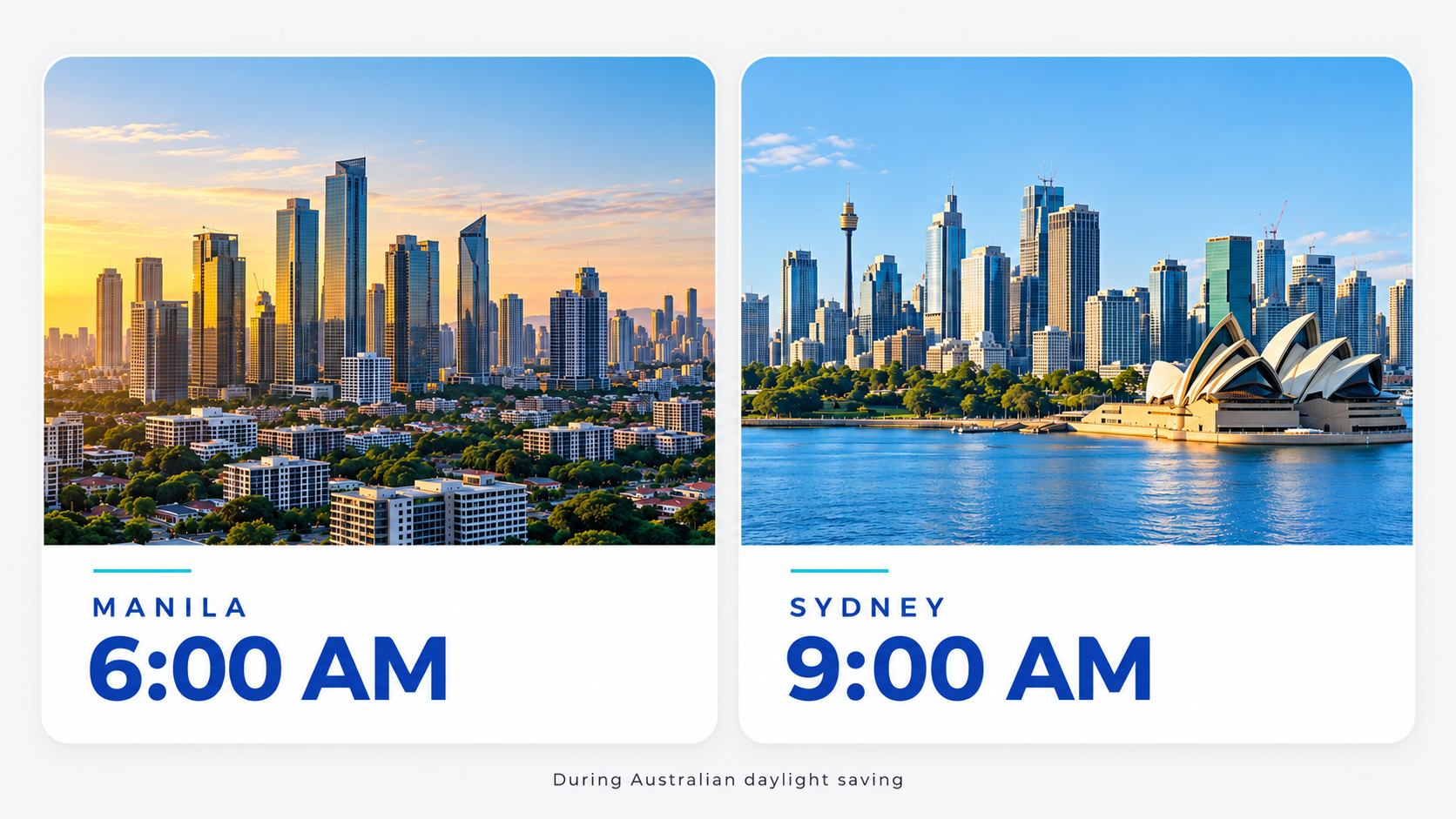
Manila is two hours behind Brisbane all year, two or three hours behind Sydney and Melbourne depending on daylight saving, and on the same time as Perth. Here is how that translates into a working day.
Manila time compared with Australia
| Your location | Outside daylight saving | During daylight saving |
|---|---|---|
| Queensland | Manila is 2 hours behind | Manila is 2 hours behind |
| Sydney, Melbourne, Canberra and Hobart | Manila is 2 hours behind | Manila is 3 hours behind |
| South Australia | Manila is 1.5 hours behind | Manila is 2.5 hours behind |
| Northern Territory | Manila is 1.5 hours behind | Manila is 1.5 hours behind |
| Western Australia | Same time | Same time |
The Philippines stays on Philippine Standard Time (UTC+8) all year. It does not observe daylight saving.
What changes when daylight saving starts?
In 2026, daylight saving starts on Sunday 4 October in NSW, Victoria, the ACT, Tasmania and South Australia. It ends on Sunday 4 April 2027.
If your team member keeps the same Manila hours, their shift falls an hour later in your local day. For example, a 7am–4pm Manila shift aligns with 9am–6pm in Sydney before the change and 10am–7pm afterwards.
If you want to keep the same Sydney hours, the Manila shift would need to move to 6am–3pm during daylight saving. Agree that change in advance with your staffing provider and team member.
The time difference stays the same for businesses in Queensland, Western Australia and the Northern Territory.
Choosing the right working hours
Start with when you need your offshore team member available. An estimator may need time for a morning briefing and an afternoon review, while an administrator answering calls may need to cover your office hours.
Match your Australian office hours
Matching the working day can be practical with an agreed earlier start in Manila. For an Australian schedule of 9am–6pm, the equivalent Manila hours are:
- Brisbane: 7am–4pm all year.
- Sydney and Melbourne: 7am–4pm outside daylight saving, or 6am–3pm during daylight saving.
- Perth: 9am–6pm all year.
These are equivalent shift windows, with meal breaks agreed separately. The schedule needs to suit the employee and the office arrangements. An earlier Australian start needs more planning: 7:30am in Sydney during daylight saving is 4:30am in Manila.
Keep a fixed Manila schedule
Your team member can keep the same local hours throughout the year if the seasonal change still leaves enough shared time. This can suit estimating, drafting and bookkeeping roles with a mix of collaboration and independent work.
Set core hours for collaboration
If you do not need to match the full day, agree when both teams will be available for questions, meetings and reviews. For example, reserve a morning check-in to brief take-offs or drawing revisions, then an afternoon review before your Australian team finishes.
What to confirm before the clocks change
- The agreed schedule. Write down the start and finish times in both locations, including breaks and whether the Manila hours change seasonally. For staff employed through Lynk, we will help confirm any changes with the employee and check office arrangements.
- Early starts. Consider commuting and whether the hours are sustainable. Eligible employees are entitled to a night shift differential of at least 10% of their regular wage for each hour worked between 10pm and 6am Philippine time. This applies to the qualifying hours, not automatically to the whole shift.
- Meetings. Check recurring calendar invites, especially if you work across several Australian states. Use city-based calendar time zones so daylight saving changes are handled correctly.
- Deadlines. Include the time zone when setting a deadline. A tender closing at 2pm AEDT closes at 11am in Manila. Allow time for your team to review the work before submission.
Setting hours with Lynk
Tell us your office location, preferred hours and when you need your team member available. We can work through a suitable schedule before they start, including how daylight saving will be handled.