Why Dedicated Offshore Staff Outperform Traditional Outsourcing in 2026

Why Dedicated Offshore Staff Outperform Traditional Outsourcing in 2026
Finding good people locally is getting harder. Salaries keep climbing,Finding good people locally is getting harder. Salaries keep climbing — trades wages rose 5.5% in 2025 — candidates are harder to lock in, and the pressure to deliver does not ease up while you wait for the right hire to come along.
Dedicated offshore staff offer a different path. They are full-time team members based overseas who work exclusively for your business, integrated into your systems and managed directly by you. This article covers what dedicated offshore staff actually are, how they differ from traditional outsourcing, which roles work best, and how to set the model up properly.
What is dedicated offshore staff
Dedicated offshore staff are full-time team members based in another country who work exclusively for one business. They sit in a professional office environment with proper infrastructure, IT support and HR backing. Unlike freelancers or shared resource pools, they work only for you, follow your priorities and report directly to your managers.
The word "dedicated" is doing a lot of work here. It means exclusivity. Your offshore team member is not juggling three other clients or waiting for the next project brief to land. They are employed through an offshore partner who handles payroll, compliance and on-the-ground support, but the work itself is directed entirely by you.
- Exclusivity: Works only for your business, not shared across clients
- Full-time commitment: Ongoing role, not project-based or task-based
- Office-based: Professional environment with infrastructure and daily support
- Integrated: Uses your systems, follows your processes, reports to your managers
How dedicated offshore staff differ from traditional outsourcing
Traditional outsourcing works like hiring a contractor. You define the outcome you want, hand it over, and the provider manages the people and delivery. The relationship is transactional. You pay for a result, not for a person.
Dedicated offshore staff flip that model. You are not buying a service. You are building a team. The staff member reports to you, works within your systems and becomes part of your company culture over time. This gives you direct oversight and control, which matters when the work is ongoing and the stakes are high.
| Factor | Traditional outsourcing | Dedicated offshore staff |
|---|---|---|
| Reporting | To the provider | Directly to you |
| Work scope | Defined tasks or projects | Ongoing role responsibilities |
| Integration | Separate from your team | Embedded in your team |
| Relationship | Transactional | Long-term employment |
| Control | Limited | Full oversight |
The practical difference shows up quickly. With traditional outsourcing, you might wait days for an update or struggle to get changes made. With dedicated staff, you simply talk to them directly, just like you would with someone sitting in your local office.
Why dedicated offshore teams deliver better results
Full-time focus on your business
When someone works exclusively for your company, they learn how things actually work. They pick up on preferences, anticipate problems and contribute more thoughtfully over time. Freelancers and agency teams juggling multiple clients rarely reach this level of familiarity because their attention is always divided.
Deeper integration with your existing team
Dedicated staff use your software, attend your meetings and communicate through your channels. They become a genuine extension of your local team rather than operating as a separate unit. This integration makes collaboration smoother and reduces the back-and-forth that often slows down outsourced arrangements.
Higher quality and stronger retention
A structured employment model with proper HR support, career development and a positive work environment leads to higher staff retention. Lower turnover means your business keeps valuable knowledge and spends less time retraining.
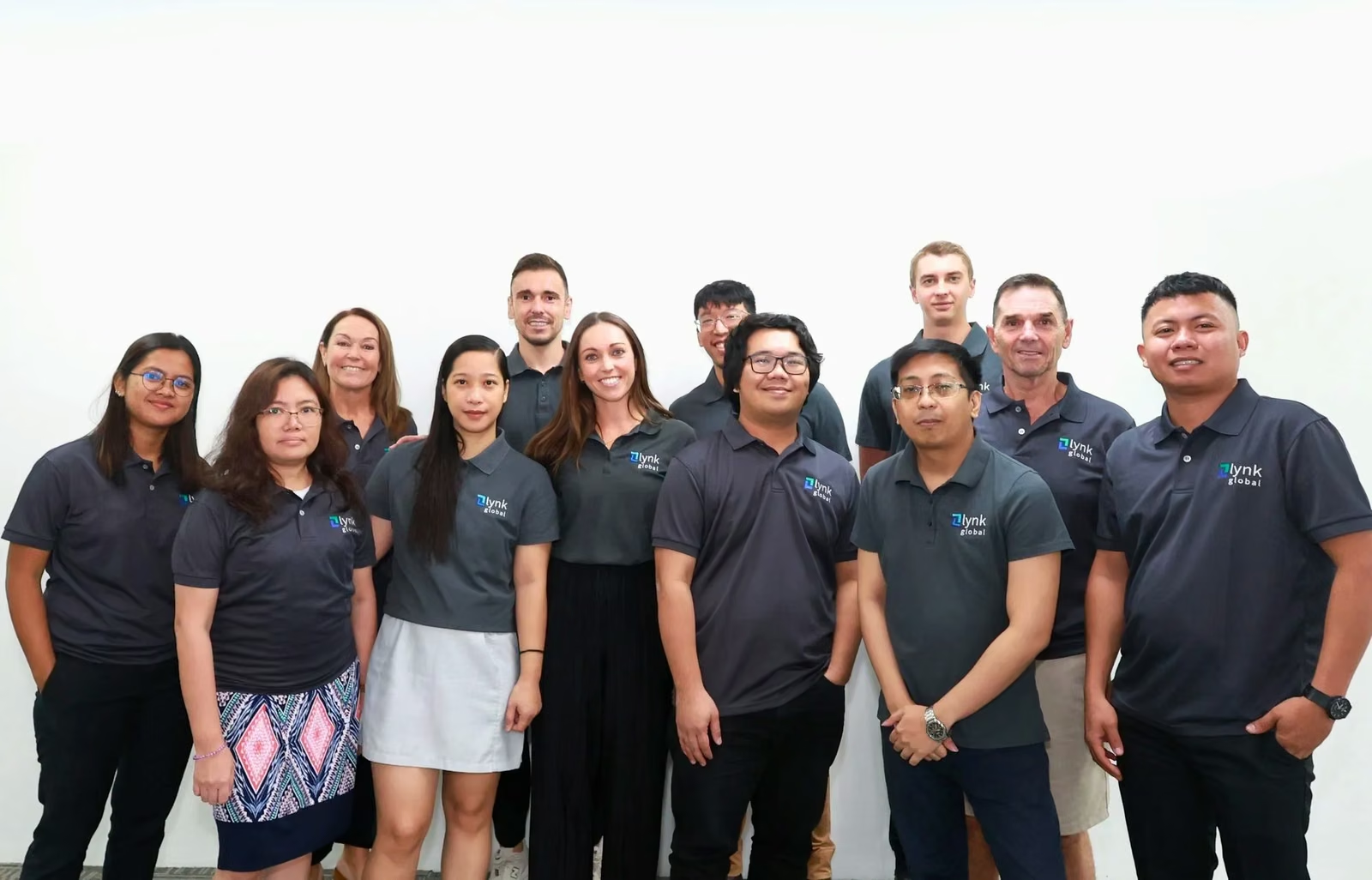
At Lynk Global, staff work from a professional office in Manila with on-the-ground management and support. This setup contributes directly to engagement and performance because people have what they need to do their jobs well.
Greater control over work and outcomes
With a dedicated team, you set the priorities, manage day-to-day tasks and oversee performance directly. You are not waiting on a third-party account manager to relay messages or chase up deliverables. This level of control is particularly important for roles that require judgement, consistency or close coordination with your local team.
Key benefits of building an offshore dedicated team
Reliable capacity without local hiring pressure
Building an offshore team allows your business to add headcount without competing in a tight local labour market. For Australian businesses facing skills shortages and high salary pressures in — with 29% of assessed occupations in shortage — and high salary pressures in construction, engineering and professional services, this creates a practical path to growth that does not depend on finding local candidates.
Access to skilled roles beyond basic admin
The perception that offshore staffing is only for low-skill tasks is outdated. The dedicated model allows you to hire for a wide range of skilled roles.
- Estimating and quantity surveying support
- CAD drafting and technical drawing
- Finance, bookkeeping and accounts processing
- Project coordination and documentation
- Administrative and operational support
These are not simple data entry positions. They are roles that require training, judgement and ongoing development.
Scalable support that grows with your business
The dedicated offshore model is inherently scalable. You can add team members one by one as workload increases, without the overhead and risk of establishing your own overseas entity. This flexibility makes it easier to respond to changing demands and growth opportunities.
Structured employment and ongoing HR support
A good offshore staffing partner handles the complex logistics of international employment. This clarifies responsibilities and ensures your staff are fully supported.
- You: Define the role, manage day-to-day work, set priorities
- The provider: Recruitment and screening, payroll processing, HR and compliance, office space and equipment, on-the-ground support
You focus on the work. The partner handles everything else.
What roles work best with dedicated offshore staff
Estimating and drafting
Estimating and drafting are skilled, detail-oriented roles common in construction, engineering and manufacturing. When staff are properly trained on your standards and integrated into your project workflows, they can produce high-quality estimates and technical drawings. This frees up your local technical experts to focus on site work, client relationships and higher-value activities.
Project support and coordination
Offshore staff can handle the critical but time-consuming tasks that keep projects moving. Scheduling updates, documentation management, progress reports and stakeholder coordination all fit well in this model. Your local project managers stay focused on delivery while the offshore team keeps the administrative side running smoothly.
Finance and bookkeeping
Functions like accounts payable, accounts receivable, bank reconciliations and financial reporting are well suited for dedicated offshore staff with the right qualifications. Accuracy and consistency matter in bookkeeping and accounts processing, and a stable, long-term team member delivers both more reliably than rotating freelancers or task-based arrangements.
Administration and operations
General administration, data entry, customer support and other operational tasks benefit from the consistency of dedicated staff. They can manage CRMs, handle routine inquiries and keep the administrative engine of your business running efficiently. Over time, they learn the nuances of your business and become genuinely useful rather than just completing tasks.
How to manage dedicated offshore staff effectively
Set clear expectations from the start
Before a new team member begins, define their role, responsibilities and reporting lines clearly. Write it down. This clarity prevents confusion and sets them up for success from day one. Ambiguity creates problems, especially across distance.
Integrate staff into your systems and processes
Provide your offshore staff with access to the same tools, software and communication channels as your local team. If your local team uses Microsoft Teams, your offshore team uses Microsoft Teams. If your local team has access to your project management system, so does your offshore team. This integration is crucial for seamless collaboration.
Communicate consistently across time zones
Establish a rhythm of communication that works for everyone. Schedule regular check-ins during overlapping hours and use asynchronous communication for non-urgent matters.
Manila time overlaps well with Australian business hours, typically just two to three hours difference. This makes real-time collaboration straightforward for most of the working day.
Treat offshore team members as part of your team
Offshore staff perform best when they feel valued and connected to the company. Include them in team meetings, share company updates and invest in building relationships. They are your staff, not external vendors. The more you treat them as part of the team, the more they will act like it.
Common challenges and how to overcome them
Communication gaps
Distance can create friction. A structured communication plan with daily check-ins, weekly team meetings and clear documentation helps bridge the gap. Ensuring a few hours of overlap in working hours is also critical for real-time problem solving.
Quality and consistency concerns
Quality issues are rarely about the staff themselves. They usually stem from poor recruitment, inadequate onboarding or a lack of professional support. The solution is to partner with a provider that has robust processes and a fully supported office environment where staff can perform well.
Time zone differences
This is a manageable challenge with the Philippines. Staff based there can easily work Australian hours with minimal adjustment. For most businesses, time zone differences become a non-issue once the working hours are aligned.
Team integration and culture
Building a cohesive culture across locations takes conscious effort. Include offshore staff in virtual team activities, all-hands meetings and company communications. Make sure they understand your values and feel like they are contributing to a shared goal, not just completing tasks in isolation.
When dedicated offshore staff is the right fit
The dedicated model works well when you are looking for ongoing, stable support rather than temporary help for one-off projects. It is particularly relevant if local hiring is slow or expensive, if you want more than task-based outsourcing, or if you value quality and staff retention over the lowest possible cost.
For businesses in construction, engineering, trades and related servicesFor businesses in construction, engineering, trades and related services facing a projected shortage of 300,000 workers by 2027, the dedicated model provides a practical way to overcome local skills shortages and build more resilient operations. The key is finding a partner who understands that offshore staffing is a long-term capability play, not a short-term cost reduction exercise.
Interested in exploring how dedicated offshore staff could support your business? Learn more about Lynk Global's approach
FAQs about dedicated offshore staff
How long does it typically take to hire dedicated offshore staff?
Most placements are made within two to four weeks once the role requirements are clearly defined. More specialised roles may take slightly longer to find the right fit.
What is the typical cost compared to local hires in Australia?
Costs are significantly lower than equivalent local salaries, though exact figures depend on the role, skills and experience level required. The savings come from lower wage costs in the Philippines combined with shared infrastructure and support.
Who employs the offshore staff and handles payroll?
The offshore staffing partner acts as the legal employer of record. They manage payroll, local taxes, government contributions and HR compliance on your behalf. You manage the work. They handle the employment logistics.
Can dedicated offshore staff work Australian business hours?
Yes. Staff based in the Philippines can easily align their schedules with Australian business hours due to the minimal time zone difference. Most teams work with significant overlap, making real-time collaboration straightforward.
What happens if a staff member leaves or underperforms?
A good partner will manage performance issues in coordination with you. If a staff member leaves, the partner handles the replacement process. At Lynk Global, replacement candidates are typically presented within two to three weeks.
Is dedicated offshore staffing suitable for small businesses?
Yes. The model is scalable and works for businesses of all sizes, including those hiring their first offshore team member. You can start with one person and grow from there as your needs evolve.
Ready to see how this works
Book a call with our team to discuss your specific needs.


