
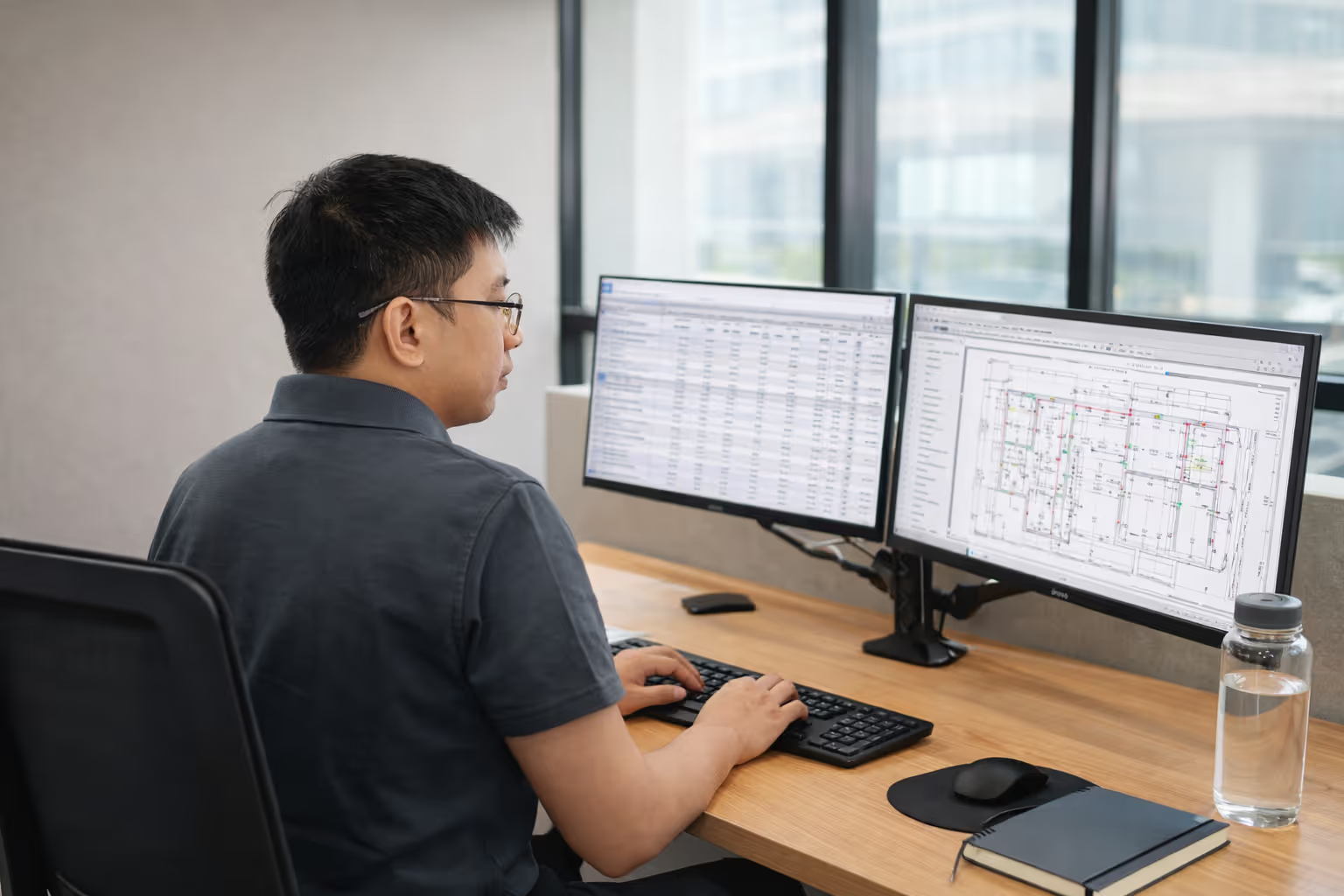
Most builders lose tenders for a simple reason: they cannot price the work fast enough. When your estimator is spending three to five days on manual take-offs and chasing suppliers for current rates, there is no bandwidth left to bid the next job. Two things are changing that in 2026, and used together they are a genuine advantage. One is AI. The other is the dedicated offshore estimator. This guide explains why the combination beats either on its own.
The short version: AI is very good at the repetitive groundwork of estimating and very bad at judgement. An offshore estimator gives you dedicated capacity to drive the tools and own the numbers, at a fraction of a local hire. Pair them and you can respond to far more tenders without adding local headcount.
What AI actually does well in estimating now
The hype has settled into something useful. In knowledge-heavy work, McKinsey estimates generative AI can lift productivity by 20 to 40 percent, and preconstruction is exactly that kind of work. In practice, today's estimating and take-off tools are reliable at a handful of specific tasks:
- Quantity take-offs, scanning drawing sets to count fixtures, measure runs and calculate areas in minutes rather than hours
- Document review, summarising specifications, addenda and RFIs so nothing important is buried in a 400-page set
- Drawing revision comparison, flagging what changed between versions so a late amendment does not slip through
- Proposal drafting, turning structured estimate data into first-draft scope, exclusions and clarifications
Industry reporting through 2026 points to take-off accuracy crossing the threshold where outputs are trustworthy with review rather than rebuilt from scratch, and to bid-preparation time falling meaningfully once these tools are embedded in the workflow. Deloitte's engineering and construction outlook makes the same broad point: AI is reshaping how capital projects are planned and priced, not as a novelty but because the volume and complexity of the work have outgrown manual methods.
Why AI on its own will not win you a bid
Here is the catch that the software demos skip. AI produces a faster take-off. It does not decide whether the quantity makes sense, whether the scope is complete, whether the labour assumption is realistic for your crews, or whether the price can win without destroying your margin. Those are judgement calls, and they still sit with a person.
So AI does not remove the estimator. It changes what the estimator spends their day on, shifting them away from clicking every object and towards reviewing assumptions, catching cost drift and pricing risk. The problem is that most small and mid-sized builders do not have a spare estimator sitting idle to do that higher-value work. The tool speeds up a step, but the bottleneck, which is skilled estimating capacity, is still there.
Why the other half is a dedicated offshore estimator
Estimators are hard to hire locally and getting harder. Quantity surveying and cost roles sit among the occupations Jobs and Skills Australia records as being in national shortage on its Occupation Shortage List, which means higher salaries and longer recruitment for anyone hiring in Australia. A dedicated offshore estimator is a way around that constraint.
An offshore estimator is a full-time cost professional, most commonly based in the Philippines, who works exclusively for your business, inside your software and templates, and reports to you directly. They are not a freelancer between clients. They prepare take-offs, cost plans, tender pricing and progress claims as part of your team, and typically cost up to 60 percent less than an equivalent local hire once you account for superannuation, leave, payroll tax and recruitment on top of salary.
Why the combination is more than the sum of its parts
Put the two together and each covers the other's weakness. The AI handles the repetitive, review-heavy grind. The offshore estimator drives the tools, checks their output, applies judgement to the numbers, and prepares a clean estimate. Your senior people are left to do only what genuinely needs them: final sign-off, contract strategy and the client conversation.
The practical effect is capacity. When bid-preparation time drops and you have a dedicated person running the process, you can respond to two to three times more tenders without hiring another estimator locally. In a market where the constraint is people rather than work, that added throughput usually matters more than any single cost saving. More bids out the door, priced accurately and on time, is what lifts win rates.
A simple way to picture the split
AI counts, measures, searches and drafts. The offshore estimator validates, prices and assembles. Your senior staff decide and sign. Nothing important is handed to a machine unchecked, and nothing repetitive is done by hand when it does not need to be.
How to set the pairing up so it works
The model succeeds when it is treated as team integration, not task dumping. A few things make the difference.
Give your offshore estimator the tools, not just the tasks
Your offshore estimator should have access to the same AI take-off and estimating software your business uses, working inside your systems rather than emailing files back and forth. The tools multiply the value of the person, so give them both.
Keep a human review layer
Treat AI output as a first pass that your estimator checks, and treat your estimator's work as something your senior staff review on the way out, especially early on. As trust builds the checking lightens, but the review rhythm should stay. The goal is estimator-led AI, not AI-led estimating.
Protect your data and drawings
You are sharing plans, pricing and client information across tools and borders, so handle confidentiality as a setup step. Clear agreements, controlled system access and defined handling of project data keep sensitive pricing safe. This is a setup task, not an afterthought.
Is this right for your business?
If you are turning down tenders because you cannot price them fast enough, or leaning on senior staff to do take-offs late at night, the AI-plus-offshore-estimator model is worth a serious look. It does not replace commercial judgement and it is not a magic button. What it does is remove the two things holding back your bidding: the slow manual grind, handled by AI, and the missing capacity, handled by a dedicated offshore estimator you can actually afford.
Lynk Global recruits dedicated offshore estimators for Australian construction businesses, matched to your systems, your software and your way of working. If you want to map which parts of your estimating workflow AI can take on and which a dedicated estimator should own, that is the conversation to start.
Want to see what offshore construction staffing could save your business?
Lynk Global works exclusively with construction companies, placing dedicated professionals in estimating, drafting, finance, and project support roles, managed from our Manila office. Australian owned.
Book a free 15-minute call or Contact us at info@lynkglobal.com.au

